

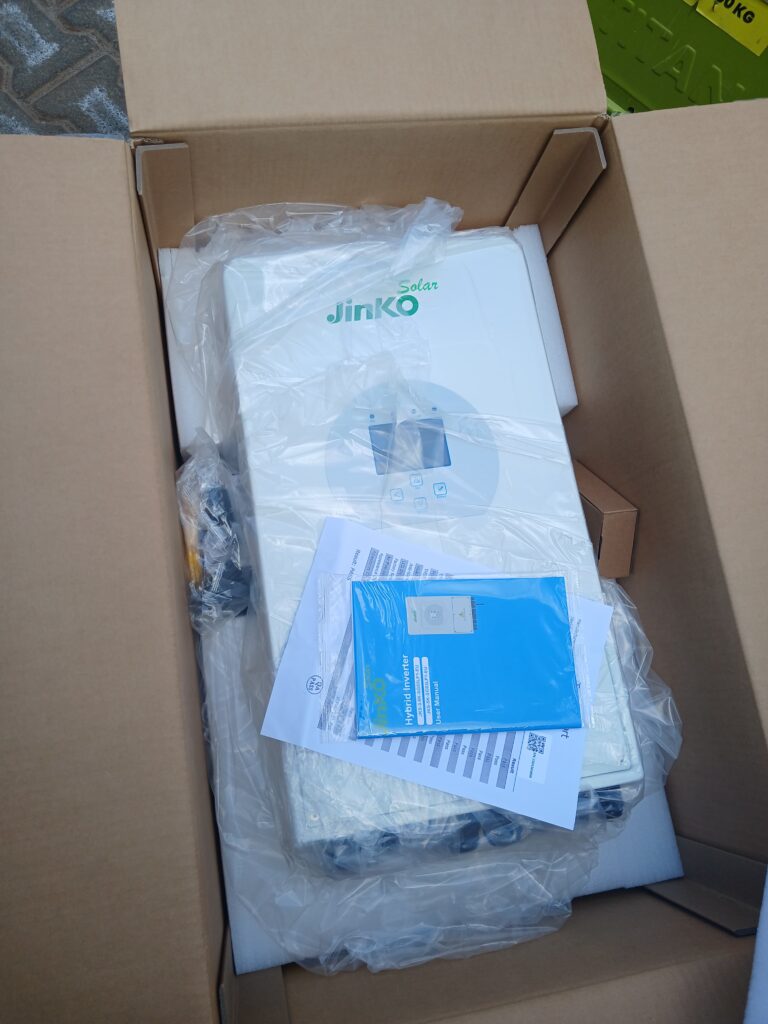

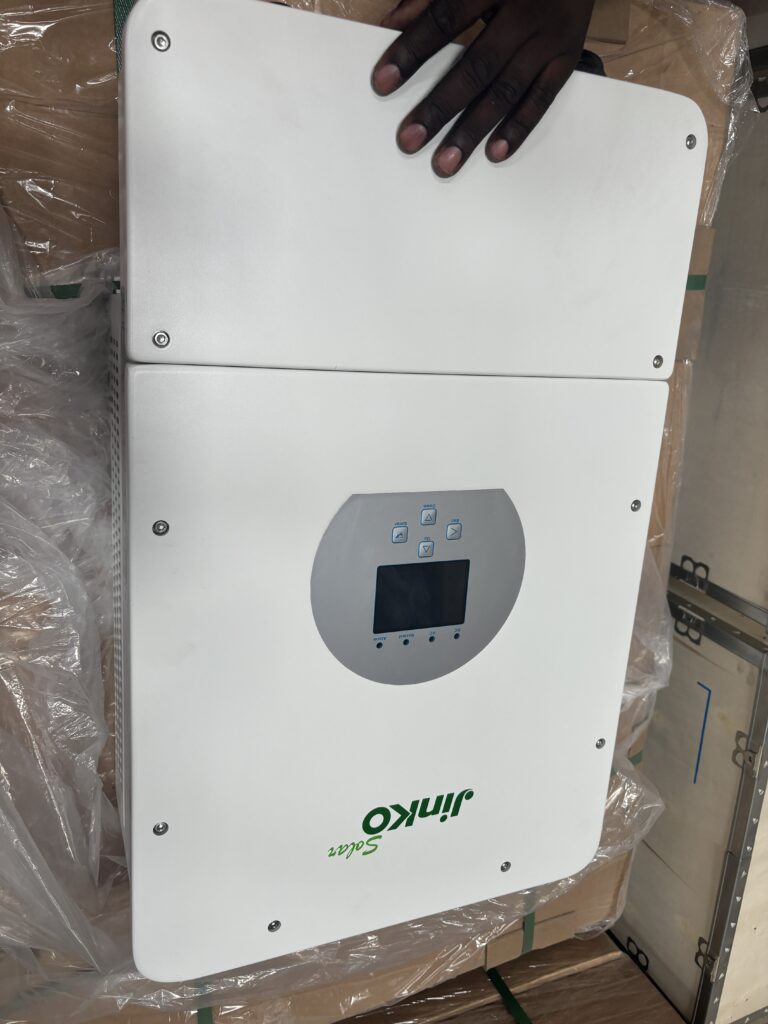
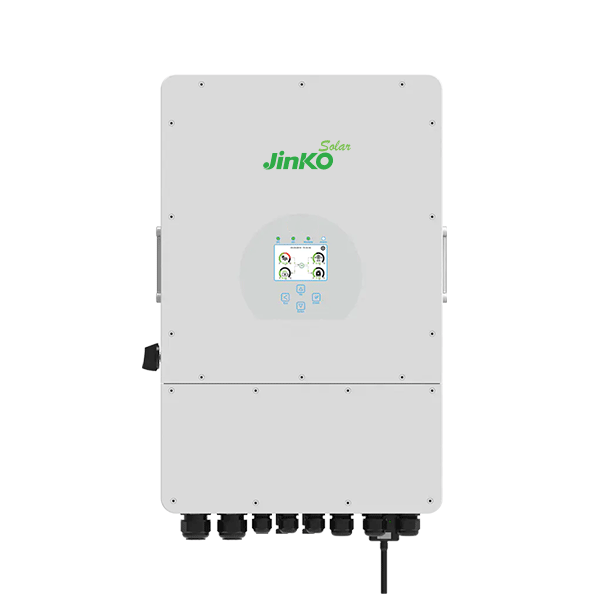
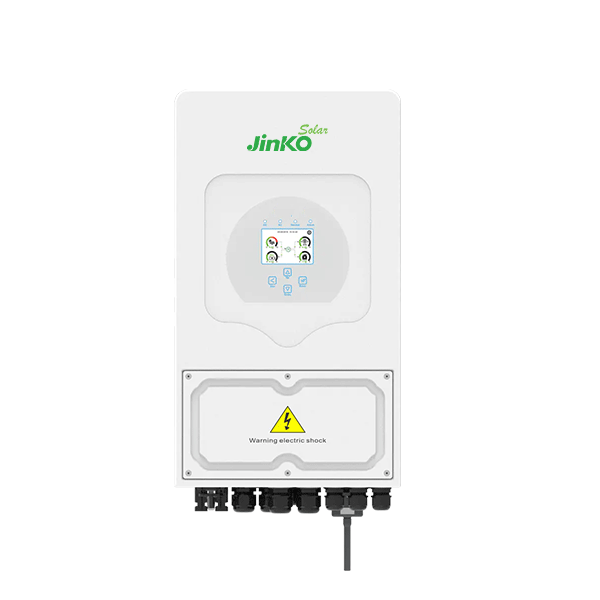
Description The Jinko 5kW 48V Single Phase Hybrid Solar Inverter (JKS-5K-SG03LP1-EU) is the residential flagship from one of the world’s most established solar brands — combining on-grid connectivity, off-grid autonomy, and battery storage management in a single weatherproof unit engineered for Kenyan conditions. Rated Output Power: 5,000W (continuous) Maximum Output Power: 5,500W Type: Single-Phase Hybrid (On-Grid Off-Grid Battery) Max PV Input Power: 6,500W MPPT Trackers: 2 independent trackers MPPT Voltage Range: 125V – 425V Max PV Input Current: 13A 13A (per MPPT) Max PV Short-Circuit Current: 17A 17A Battery Voltage: 48V nominal Battery Compatibility: Lithium-ion (LiFePO4) and Lead-Acid Max Charge/Discharge Current: 120A Max Efficiency: Up to 97.6% MPPT Efficiency: >99%</li> <li><strong>AC Output Voltage:</strong> 230V / 50Hz (single phase)</li> <li><strong>UPS Switchover Time:</strong> <16 milliseconds99% AC Output Voltage: 230V / 50Hz (single phase) UPS Switchover Time: Communication: RS485, CAN, Wi-Fi (optional) Protection Rating: IP65 (indoor and outdoor installation) Operating Temperature: -25°C to 60°C Parallel Operation: Supported (expandable for larger systems) Generator Compatible: Yes Weight: 33.6 kg Dimensions: 422 × 699 × 279 mm Warranty: 5 years standard Model: JKS-5K-SG03LP1-EU SKU: JK-INV-5K-SP The 5kW Hybrid Inverter Most Kenyan Homes Actually Need The Jinko JKS-5K-SG03LP1-EU is the sweet spot of residential hybrid inverters for the Kenyan market. It’s large enough to comfortably power a 3-bedroom home with typical appliances, small enough to fit cleanly on a wall-mounted installation, and versatile enough to work as a pure on-grid system today, a hybrid system when you add batteries, or a full off-grid system when grid power fails completely. Jinko (NYSE: JKS) is best known as the world’s largest solar panel manufacturer, shipping over 90GW of modules in recent years. Their expansion into hybrid inverter and energy storage systems follows the same vertical-integration philosophy that made their panels ubiquitous in Kenyan rooftops — giving installers the option to build a complete matched system from a single brand. What “Hybrid” Actually Means on This Inverter The word “hybrid” gets thrown around loosely in the Kenyan solar market. On the JKS-5K-SG03LP1-EU, it specifically means the inverter can simultaneously manage four different energy sources and destinations: Solar panels connected to the dual MPPT inputs, generating DC power during the day Utility grid power, which the inverter uses for pass-through operation and battery charging when solar is insufficient Battery storage, either lithium-ion (LiFePO4) or lead-acid, for night-time and outage backup Household loads, drawing power from whichever source is cheapest or most available at any given moment The inverter’s energy management system decides, second-by-second, where each watt should come from. When the sun is shining, it prioritises solar for your loads and charges the battery with the surplus. When the sun goes down, it discharges the battery to cover your evening load. When the battery is depleted or the load exceeds capacity, it seamlessly pulls from the utility grid. When the grid fails, it switches to UPS mode in under 16 milliseconds — fast enough that even sensitive electronics don’t notice. Dual MPPT Trackers: Why Two Is Better Than One The JKS-5K-SG03LP1-EU has two independent Maximum Power Point Tracking inputs, each capable of handling up to 13A of PV input current (17A short circuit). This is one of the most important practical features of the inverter, and it’s the reason it works well on the complex roof layouts common in Kenyan homes. A single-MPPT inverter forces all your solar panels onto one electrical string, which means every panel on the roof must face the same direction at the same angle. If your roof has an east-facing section and a west-facing section, a single-MPPT inverter will underperform on both — the shaded or less-exposed side drags down the output of the fully-exposed side. With dual MPPT inputs, you can run one string on your east face and another string on your west face (or north and south, or any other combination), and each MPPT tracker independently optimises its own string. The result is measurably more energy harvested across a full day, especially on homes with hip roofs, broken roof segments, or partial shading from trees or water tanks. Recommended Solar Panel Configurations With 6.5kW maximum DC input power and an MPPT voltage range of 125–425V, the JKS-5K-SG03LP1-EU comfortably handles the following panel configurations: With Jinko Tiger Neo 580W panels: 10–12 panels total (5.8–6.96kW DC), arranged as two strings of 5 or 6 panels each on the dual MPPT inputs With Canadian Solar 550W HiKu6 panels: 10–12 panels total, similar dual-string configuration With Canadian Solar 450W HiKu6 panels: 12–14 panels total, more suitable for constrained roof layouts With mixed or asymmetric roof layouts: Up to 12 panels split between two MPPT inputs in any ratio that fits your roof Battery Compatibility: Lithium and Lead-Acid This is an underrated feature. Many modern hybrid inverters only support lithium batteries, which forces customers to spend the full lithium premium upfront. The JKS-5K-SG03LP1-EU supports both battery chemistries, which gives you three practical options: Start with lithium now: If your budget allows, pair the inverter with a lithium battery bank from our Jinko, Renergy, or Vestwood ranges (5kWh, 10kWh, or 15kWh) for maximum cycle life, depth of discharge, and daily energy throughput. Start with lead-acid, upgrade later: If the upfront cost of lithium is a barrier, start with deep-cycle lead-acid batteries and upgrade to lithium when your budget permits. The inverter handles both chemistries without requiring hardware changes. Start grid-tied, add batteries later: The inverter works perfectly well without any battery connected at all. You can install it today in a pure on-grid configuration and add batteries in 6 months or a year when you’ve saved up. The maximum charge and discharge current is 120A, which comfortably covers most residential battery banks without throttling. System Sizing Examples for Kenyan Homes Here are three realistic configurations for typical Kenyan households, each built around the JKS-5K-SG03LP1-EU: Configuration 1: 3-Bedroom Home with Standard Loads 10 × Jinko Tiger Neo 580W panels (5.8kW DC) JKS-5K-SG03LP1-EU inverter 10kWh lithium battery (Jinko, Renergy, or Vestwood). Covers lights, TV, fridge, phone charging, laptop, small kitchen appliances, and overnight backup for essentials. Suitable for homes with average daily consumption of 15–25 kWh. Configuration 2: 4-Bedroom Home with AC 12 × Canadian Solar 550W HiKu6 panels (6.6kW DC) JKS-5K-SG03LP1-EU inverter 15kWh lithium battery from our Jinko, Renergy, or Vestwood range. Covers the above plus running an air conditioner during peak heat hours. Suitable for homes with daily consumption of 25–35 kWh. Configuration 3: Small Business / Shop 10 × Canadian Solar 545W HiKu6 panels (5.45kW DC) JKS-5K-SG03LP1-EU inverter 10kWh lithium battery (Jinko, Renergy, or Vestwood). Covers shop lighting, refrigeration, POS systems, Wi-Fi, and a computer. Suitable for shops and small offices operating 10–14 hours per day. Full Technical Specifications PV Input Data: Max DC Input Power: 6,500W Rated PV Input Voltage: 360V MPPT Voltage Range: 125V – 425V Full Load DC Voltage Range: 150V – 425V Start-up Voltage: 125V Max PV Input Current per MPPT: 13A Max PV Short-Circuit Current per MPPT: 17A Number of MPPT Trackers: 2 Strings per MPPT: 1 AC Output Data: Rated AC Output Power: 5,000W Max AC Output Power: 5,500W Peak Power (Off-Grid): 10,000W for 10 seconds Rated AC Output Current: 21.7A Max AC Current: 25A Max Continuous AC Pass-Through: 40A Power Factor: 0.8 leading to 0.8 lagging Output Frequency: 50Hz / 60Hz Output Voltage: 230V (single phase) Battery Input Data: Battery Type: Lithium-ion (LiFePO4) or Lead-Acid Battery Voltage Range: 40V – 60V Max Charging Current: 120A Max Discharging Current: 120A External Temperature Sensor: Supported Charging Strategy for Li-Ion: Controlled by battery BMS via CAN/RS485 Efficiency and Protection: Max Efficiency: 97.6% European Efficiency: 97.0%
Related products
Nicotine Pouches
$ 91.12
Nicotine Pouches
$ 99.23

Nicotine Pouches
$ 94.48

Nicotine Pouches
$ 100.00

Nicotine Pouches
$ 93.49

Nicotine Pouches
$ 94.14
Velo Nicotine Pouches
$ 98.41
Velo Nicotine Pouches
$ 97.22